
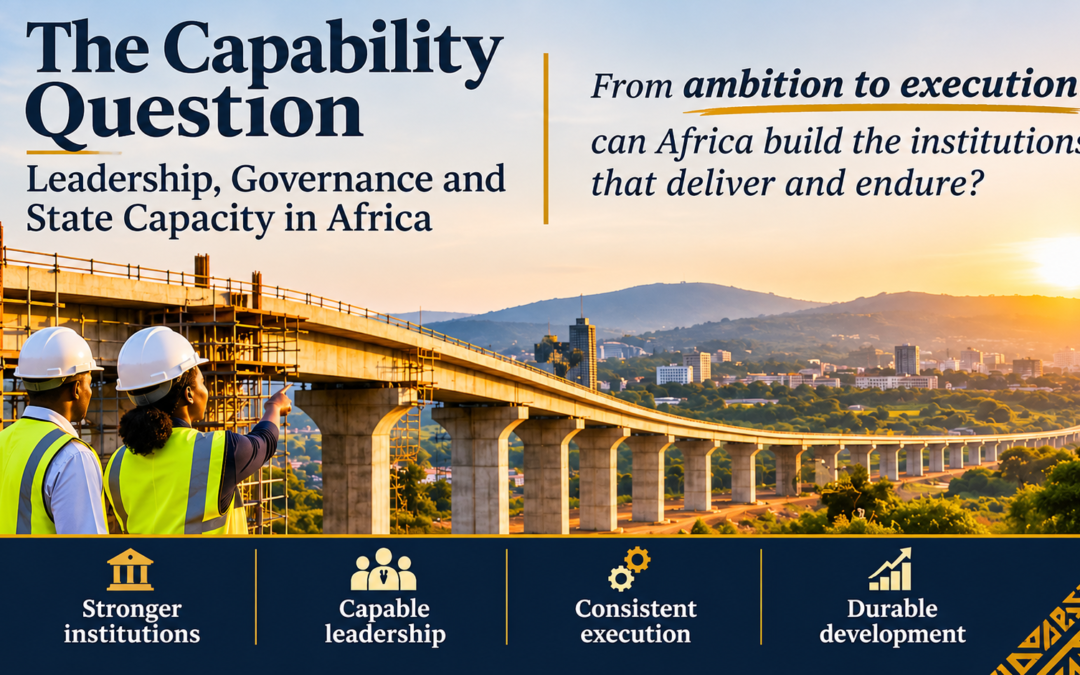
Africa’s challenge is increasingly not the absence of ideas, resolutions, resources or strategic opportunity, but the uneven institutional capability required to execute transformation consistently over time.
The Capability Gap
The capability gap in Africa is a defining paradox. While the continent possesses abundant physical resources and demographic assets, systemic institutional bottlenecks, such as fragmented stakeholder landscapes, policy misalignments, absence of strategic continuity and weak governance frameworks frequently paralyse execution.
Governance Beyond Corruption
Governance refers to how state and society interact. Corruption weakens institutional capability by breaching the social contract, undermining public trust and redirecting scarce state capacity away from long-term developmental priorities toward short-term extraction and patronage. Governance in this context is closely linked to capability, implementation and continuity. While African states often demonstrate strong political and policy-making capacities, their technical capabilities for execution and delivery typically lag. The ‘Islands of Excellence’ paradox is a phenomenon where specific state agencies, and highly successful institutions exist within a broader national context of systemic poverty, weak governance, and underdevelopment. Because these ‘pockets of excellence’ exist in a vacuum, their best practices do not raise overall standards.
Political and bureaucratic fragmentation prevents these isolated successes from transforming entire economies or public sectors. Scaling these models requires broader systemic alignment and committed political will and vision. Governance as capability represents the evolution from drafting ideal policies to building resilient institutions. This shift enables policies to survive political transitions, withstand crises, and effectively deliver public services by continuously empowering administrative capacity and frontline execution. There is therefore the need for continually deepening and widening these pockets of excellence.
Fragmented Execution
Inconsistent institutional capacities stem from a combination of fragmented institutional landscapes and a disconnect between local socio-economic realities and standardized governance models. Because institutions lack the capacity to faithfully execute development policies, many institutional frameworks become decoupled from national realities. Reports and strategic plans are routinely produced, but the practical capability to translate these into public goods or economic growth remains crippled. This creates deep disparities in efficiency, reliability, and regulatory enforcement. Ministries and departments often act in silos without interconnectedness or coordination.
Sustained political stability is a critical precondition for long-term economic transformation. Institutional fragility coupled with short political cycles, frequently disrupts long-term national execution capacity. Electoral cycles, designed to harmonise elections and reduce costs, also introduce structural limitations. Large-scale infrastructure, energy reform, and industrial policy programmes, central to transformation or industrialisation, require long-term planning and implementation horizons. Infrastructure-led growth strategies in developing economies often require consistent policy continuity over multiple years to deliver measurable impact. In most cases, with a change of government there is a break in policy resulting in programmes being interrupted or discontinued.
Durable institutions are rarely constructed through abrupt restructuring or constitutional reform. Rather, they depend on the gradual development of administrative competence, regulatory credibility, policy continuity and public trust. Institutions strengthen when technical expertise is retained, implementation systems are protected from constant political disruption and long-term national priorities remain consistent across electoral cycles. Capability therefore emerges less through institutional proliferation than through sustained coordination, disciplined execution and strategic patience. State capability strengthens when institutions are allowed to learn, adapt and develop technical depth over time rather than being repeatedly disrupted by political turnover or endless reform cycles.
Leadership and Incentives
The capability question regarding leadership, governance, and state capacity in Africa centres around the continent’s ability to transition from reliance on ‘heroic’ political personalities to the establishment of competent institutions capable of driving sustainable transformation. Strong institutions require capable leadership to build, protect and continuously strengthen them. Institutions do not emerge or sustain themselves automatically. Africa needs both capable institutions and capable leaders, but institutions are what make progress durable.
Africa requires strong systems capable of sustaining strategic continuity beyond individuals. Personality-centric leadership creates discontinuity, implementation fragility, policy reversals and weak succession systems. While institution-centric models provide continuity beyond individuals, durable institutions rarely emerge or survive without capable leadership committed to strengthening rather than undermining them.
Countries such as Rwanda, China and Singapore illustrate how sustained policy continuity, long-term planning and implementation discipline can contribute to accelerated development, notwithstanding their significantly different political and institutional contexts. The lesson is not that their models of governance should be replicated, but that development requires consistency of strategic direction and execution over time. For African democracies, the challenge is how to preserve the continuity of policies, programmes and national priorities across successive administrations without relying on prolonged political tenure. The deeper task is therefore not merely to identify competent, visionary leaders, but to build institutions capable of sustaining long-term national priorities across successive administrations.
State Capacity as Strategic Infrastructure
State capacity extends beyond political authority or policy ambition. It reflects the practical ability of institutions to implement decisions consistently, coordinate across sectors, mobilise resources effectively and sustain long-term national priorities beyond political cycles. Capable states maintain institutional memory, enforce regulatory standards, deliver public services reliably and create conditions for industrialisation, investment and social stability.
Strategic continuity in Africa refers to the long-term planning, geopolitical alignment, and economic resilience required to manage the continent’s rapid growth. It demands institutions that enable industrialisation and coordination. It involves shifting from external dependence to internal coordination, regional trade (AfCFTA), and securing supply chains against global shocks.
The implementation challenges surrounding continental initiatives such as AfCFTA also demonstrate that integration ultimately depends not only on political ambition, but on the institutional capability required to coordinate regulation, infrastructure, trade systems and long-term policy execution across multiple states.
Conclusion
Africa’s future will not be determined solely by resources, demographics or strategic opportunity, but also by the institutional capability to translate vision into execution consistently over time. Governance, therefore, is not merely a political question, but a strategic question of policy coordination, execution continuity and state capacity. In an increasingly fragmented global order, the capability question is ultimately about whether African states can transform ambition into strategic policies and plans which produce sustained execution, convert continuity into transformation, and translate political vision into long-term developmental outcomes through resilient institutions.
While capability gaps remain significant across much of the continent, Africa is not without institutional examples from which lessons can be drawn. Botswana’s Sustainable Budget Index illustrates an institutional approach to managing mineral revenues and prioritising long-term investment. Namibia’s community-based conservancy framework demonstrates how legislation and local institutions can support sustainable natural resource management and community participation. Ghana’s efforts to strengthen and integrate its public financial management systems illustrate the continuing process of building institutional capability. These experiences, notwithstanding their limitations and uneven outcomes, demonstrate that institutional capacity can be deliberately developed within African contexts. The challenge is to strengthen, adapt and sustain such institutions so that they deliver meaningful development outcomes across generations.
In an increasingly fragmented global order, Africa’s future will depend not only on resources, leadership or strategic opportunity, but on the capability to translate vision into execution consistently through the patient construction of institutions capable of sustaining strategic continuity across generations.