
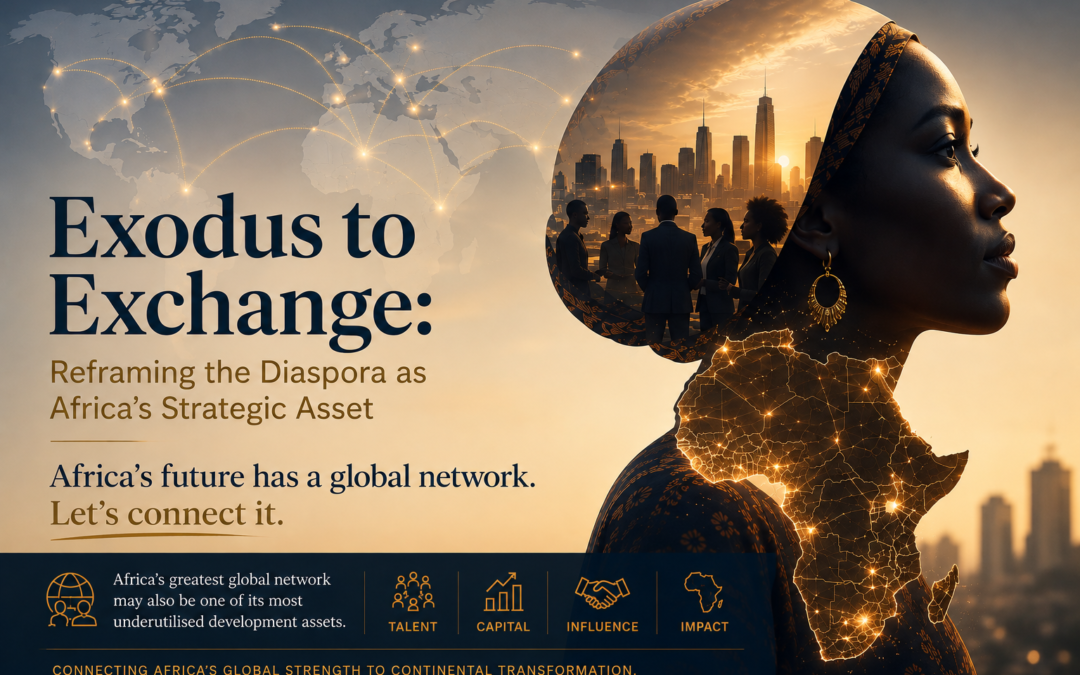
Africa possesses one of the world’s most globally dispersed pools of talent, expertise and entrepreneurial capability, yet lacks the institutional mechanisms to systematically convert that global presence into long-term strategic and developmental advantage.
The narrative surrounding African Diaspora has long been oversimplified and bifurcated. On the one hand it is framed as brain drain, a haemorrhaging of skill and human capital, crippling development. On the other it is celebrated as a source of remittances, reduced to an economic lifeline for propping up households. This essay challenges that narrative and presents the case that the African diaspora is neither a lost cause nor a cash cow but a latent transnational epistemic and economic community. Beyond the simple loss and gain theory lies a mismatch between the African continental system and its offshore human resources: a fundamental failure to productively interface with its global community.
Introduction: Beyond the Binary of Loss and Gain
The archetype of the African migrant is globally ubiquitous. From the Ghanaian surgeon in a London teaching hospital to the Ethiopian tech entrepreneur in Silicon Valley, the Kenyan academic in a Canadian think tank, and the Nigerian artist dominating the global Afrobeats scene, the African diaspora is a staggering export of talent. Numbering over 200 million with a remittance inflow of over $100 billion, the material footprint is undeniable. Yet, the discourse remains intellectually trapped. The ‘brain drain’ thesis views this phenomenon as a zero-sum depletion, morally indicting the ‘fleeing’ emigrant. The ‘brain gain’ counter-thesis points to remittances, return migration, and technology transfer as net benefits. Both theories assume a fixed framework of the continent, failing to capture the fluid, globalised reality of contemporary African identity.
Diaspora communities possess a unique advantage: the ability to operate across borders, connecting global networks, capital, expertise and institutions with opportunities on the continent. The central challenge for Africa is not to stop migration, an impossibility in a globalised economy, but to construct the institutional architecture to convert this diffuse global network into a structured force for continental transformation. The question is no longer ‘How do we stop the brain drain?’, but ‘How do we achieve brain circulation across the African ecosystem?’
Case studies in Diasporic Agency: Models of Pan-African Engagement
The Venture Capitalist Model: Diaspora De-risking African Markets for Reluctant Investors
The diaspora does not just bring money; it imports the due diligence culture, corporate governance standards, regulatory literacy and global networks necessary for continental integration. In uncertain times, foreign investors seek on-ground validation. Diaspora businesses and professionals act as due diligence partners, reducing perceived political and logistical risks.
Diaspora de-risk African markets for foreign institutional capital by acting as credible translators of local business environments. The arbitrage of context is the diaspora’s superpower – leveraging cross-cultural fluency to bridge host societies with the continent of origin. This transforms decentralised global networks into a powerful engine for strategic, economic, and social innovation.
The Academic/Policy Entrepreneur Model: Reversing the Flow
The diaspora academic is a vector for decolonizing the curriculum, not from a posture of abstract activism, but by integrating the African academy into global research consortia on climate adaptation & sustainability, ‘green’ science, tropical medicine, and AI ethics.
Co-designing continental curricula with diasporan academics counters provincialism inherent in many national university systems, fostering a Pan-African scholarly network.
The Shape of the Diaspora: A Class Apart
To understand its potential, one must dissect the demography. Unlike many diaspora formations born of war or agricultural dislocation, the Nigerian diaspora, for example, is disproportionately high-skilled. Nigerian immigrants are consistently ranked by the OECD as one of the most educated cohorts in the United States and Europe. This is not merely a middle-class migration or export labour; it is an export of epistemic authority.
The Structural Impediments: Disarticulation and Mistrust
If the potential is immense, why has it not yet scaled to continental impact? The analysis must shift from romanticising the diaspora to critiquing the host and home states. The primary blockage is institutional disarticulation – a profound mismatch that occurs when the skills, capital and progressive policies offered by the diaspora collide with the reality of what the African continent can absorb.
First, there is a recipient capacity deficit. Many African states lack the absorptive complexity to utilize high-level skills. A diaspora engineer returning to fix the national grid is confronted not by technical problems, but by a political economy where erratic power supply is a multi-billion-dollar rent-seeking machine. The diaspora is not failing Africa; the predatory political economy often actively rejects the efficiency the diaspora embodies.
Second, the psychological contract is broken. The diaspora is viewed by the political elite not as a partner in nation-building, but as a diaspora of ‘cowards’ who fled, or simply as a fiscal extraction point via remittances and diaspora bonds. For many within the diaspora, migration was neither an act of abandonment nor a pursuit of adventure, but a response to accumulated frustration with governance failure, insecurity, economic instability and constrained opportunity. A history of transactional engagement, such as the Nigeria Diaspora Fund, which has suffered from opacity and politicization, cements mistrust. There is no political representation, no meaningful voting rights, and no institutionalized voice. You cannot expect a community to invest emotionally and financially in a continent that structurally excludes them from its political calculus.
We also must distinguish between physical diaspora and virtual diaspora. The former requires complex return migration logistics. Virtual diaspora, however, bypasses geography entirely.
If Africa is to move beyond symbolic engagement with the diaspora, the challenge is no longer simply one of migration, but of institutional design. The question is how fragmented pools of African expertise, capital and networks can be integrated into long-term continental development in structured and politically sustainable ways.
Pillar 1: The Structured Knowledge Exchange Bank (SKYB)
Move beyond ad-hoc mentorship to a continental digital repository, backed by the AfDB and Afreximbank, that acts as a clearing house. Ministries across Africa would lodge technical challenges (e.g. designing a commodity exchange clearing system for Ethiopia). Diaspora professionals globally bid or volunteer their time via a secure, credentialed portal. This unbundles intellectual labour from physical presence, turning the entire diaspora into a massive, on-demand pro-bono consultancy – a ‘Diaspora Cloud’ for African governance, unleashing brain circulation.
Pillar 2: Originating Diaspora Venture Funds with a Continental Mandate
Remittances are consumption; investment is transformation. African governments should stop simply issuing diaspora bonds for generic budget support. Instead, they must co-fund (with sovereign wealth funds) ‘Diaspora Innovation Funds’ with a strict Pan-African mandate. This is catalytic capital. A fund managed by a board comprising majority members from the Nigerian, Kenyan, Rwandan, South African and Ghanian diasporas, tasked with deploying into agritech and logistics startups linking African markets, would innately possess the cultural competence and technical rigour that purely foreign funds lack. This is a pragmatic redistribution of agency, handing the capital to the diaspora to invest on the continent’s behalf, with AfDB and Afreximbank backing and coordinated by the AU with AfCFTA as the driving mechanism.
Pillar 3: Political Inclusion – The Constituency of the Exterior
Ultimately, this is a political question. The depoliticized, purely economic engagement is fragile. Models like Senegal’s dedicated parliamentary seats for the diaspora or Italy’s diaspora representation must be Pan-Africanized. The AU’s Economic, Social and Cultural Council (ECOSOCC) should host a formal Diaspora Caucus with binding advisory power on continental trade (AfCFTA) and migration policies. A stake in the political process transforms the remittance-sender into a citizen-stakeholder in the African project.
Conclusion: The Diaspora as a Mirror to Africa’s Future
The African diaspora is a magnifying glass on the African condition. The desire to leave is not a repudiation of identity, but a symptom of a continent whose immense potential has been constrained by governance failures. Diaspora come in different forms: political asylum seekers, genuinely fearing reprisals, economic migrants seeking better opportunities for their families, academic migrants frustrated by broken education systems. To treat the diaspora merely as a brain drain is to blame the victim of structural adjustment and policy rot. To treat it merely as a wallet is myopic extraction. The failure to leverage the diaspora is a failure of imagination in distinguishing between the mobility of bodies and the mobility of intellect and capital.
The pathway forward is the deliberate, audacious construction of a Pan-African epistemic and economic commons – a bridge between Global Africa and the continent itself. This framework is associated with risks such as creation of gatekeeping elites, brain drain exacerbation, and expectations of preferential treatment. Strategy must align diaspora incentives with local majority interests to avoid resentment. Continental coordination is vital to changing the perception of diaspora from catastrophic brain drain or basic remittances to one of ‘Global Africa’ – a multi-yielding investment and an engine for institutional wealth-building and inclusive growth on the continent. In essence, as the old global order becomes fragmented, the diaspora is not an auxiliary resource, but a distributed and invested network that can act where states hesitate. The winners will be those African nations that move from ‘diaspora as remittance source’ to ‘diaspora as co-owner of national and regional strategy’.
When a Nigerian data scientist in Berlin can seamlessly collaborate with a policy analyst in Accra to audit government procurement using blockchain, when a diaspora venture fund can route capital from Toronto into a logistics chain linking Abidjan to Bamako, then the exodus ceases to be a loss. It becomes a pre-positioned network. The millions who left may yet be revealed not as Africa’s lost children, but as its most strategic global asset, waiting not for a boat back home, but for a legitimate, intelligent, and Pan-African bridge to walk across. The crisis is not the diaspora; the crisis is the absence of the bridge. Building it is the defining political task of our time.