
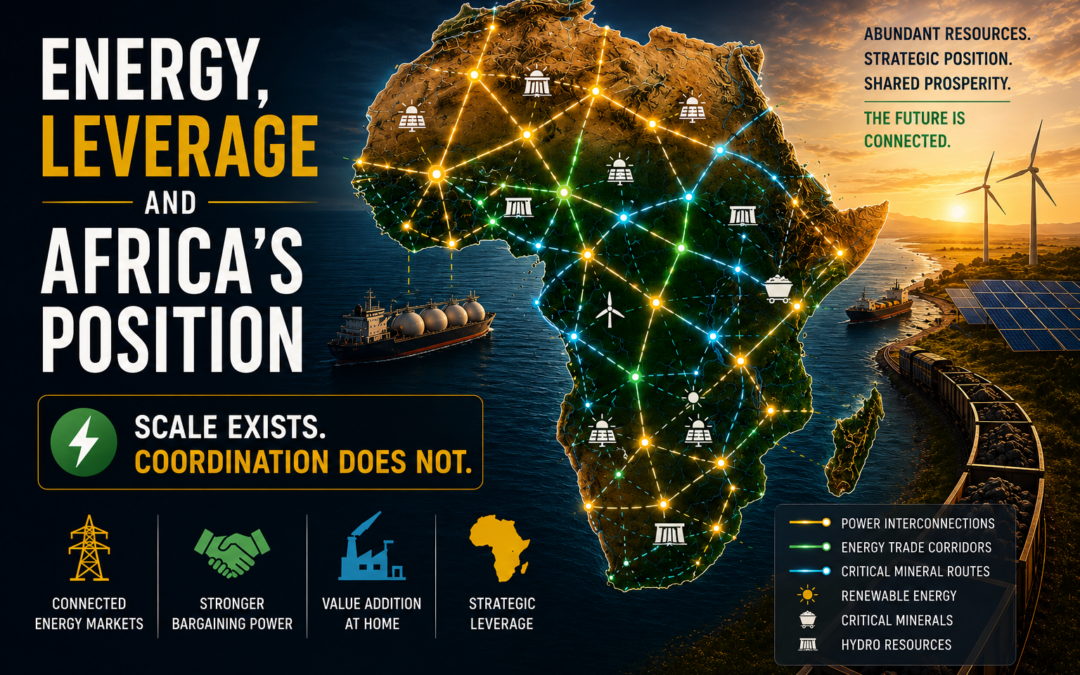
Africa is central to global energy supply. From conventional to critical minerals, its energy potential is not in question. What is less often acknowledged is how much of that potential remains structurally underutilised, not because of resource constraints, but because of fragmented positioning. The misdiagnosis often focuses on investment gaps, infrastructure deficits, or external constraints. While these matter, they are not the core issue. The deeper constraint is fragmentation. In an increasingly transactional global system, coordination becomes a source of strategic leverage. Without it, endowments and scale do not translate into influence.
The cost of fragmentation is illustrated by Africa’s energy systems. Sixty percent of the world’s best solar resources are found on the continent, yet it receives less than three percent of global energy investment and six hundred million people lack reliable electricity. While generation capacity is rapidly growing, transmission and distribution networks needed to deliver the power are lagging. Fragmented markets with isolated, inadequate and expensive national grids undermine regional energy interconnectivity required to unlock efficiency, affordability and renewable growth. Scale exists, but coordination does not.
Regional energy interconnectivity fosters intra-African electricity trade, which like goods and services allows countries to share electricity during peak demand or outages, trade surplus power and enable economies of scale for bulk purchasing. Larger continental markets support shared infrastructure, more efficient resource allocation and greater investment in renewable energy projects. This promotes energy independence. Regional power pools, currently at varying stages of development and operation, are paving the way for the AU’s vision of a continent-wide interconnected power system (the Africa Single Electricity Market) that will serve 1.4 billion people across 55 countries, making it the biggest electricity market in the world. Coordinated policies drive investment and sustainable growth leveraging the continent’s significant renewable energy potential and estimated $2.5 trillion energy infrastructure opportunity.
A similar dynamic is visible in Africa’s position in critical minerals. While the continent holds significant reserves essential to the global energy transition, value capture remains limited. African nations risk missing out on the opportunities offered by the global race for these resources without a coordinated approach. With the expiry of AGOA [the African Growth and Opportunity Act] African countries are being encouraged to negotiate individually with the United States. In 2024, the African Union drafted a continent-wide green minerals strategy with the aim of developing African supply chains, as well as expanding processing and value addition in the region. However, this has not worked in practice as countries continue to pursue bilateral agreements. This lack of coordination weakens Africa’s collective bargaining position with foreign investors and limits its ability to mobilise capital and capture value. Weak value capture rooted in a reliance on exporting raw, unprocessed minerals (such as cobalt, copper, and manganese) rather than developing local processing and manufacturing capacity locks Africa into a commodity-exporter mode.
What could continental coordination look like? Proceeds from mining minerals – which create few jobs – would fund education and human development rather than being elevated to a standalone growth strategy. Agriculture would receive more attention given the abundance of arable land, and a focus on getting reliable electricity to businesses to boost production would be prioritised.
The impact of fragmentation is visible in energy systems more broadly. Disruptions in critical chokepoints such as the Strait of Hormuz illustrate how control over energy flows translates directly into global leverage. It is estimated that the Middle East accounts for around 16 percent of Africa’s imports, with current disruptions in its energy and fertilizer corridors projected to impact commodity prices, create inflationary pressure and slow economic growth. Exposure to these shocks is not simply a function of geography, but of structural positioning. The lesson is clear: without coordination, vulnerability to external shocks remains high. With efforts to bypass the Strait, Africa, particularly West Africa, is emerging as a safer, Atlantic-facing alternative. The crisis serves as a wake-up call for African economies to enhance energy independence through intra-African trade and energy security.
What is being left on the table is not marginal, it is structural. Africa’s fragmentation limits its ability to influence pricing, capture value within supply chains, and negotiate from a position of strength. Instead of acting as a coordinated actor, it remains a price taker in systems it helps to supply. While external actors are acting strategically, Africa often reacts opportunistically rather than shaping outcomes collectively.
Coordination is harder than simple alignment on interests. A major constraint is that the AU is not a supranational body with the legal authority to negotiate trade deals on behalf of member states, unlike the EU. This hampers collective bargaining with trade partners. Furthermore, existing institutional frameworks, including AfCFTA, were not designed to operate as geopolitical instruments. Their evolution will necessarily be gradual. But the pace of global change is not gradual. The question is not whether these frameworks can evolve. It is whether Africa can begin to act more coherently within them – aligning positions, coordinating engagement and strengthening its capacity to shape outcomes, even before formal transformation is complete.
Effective coordination ultimately depends on leadership and capable institutions able to sustain collective action, align incentives and translate shared interests into durable policy. Coordination alone is insufficient. Strategic leverage ultimately depends on the institutional and technical capability required to implement shared priorities and convert resource endowments into productive capacity.
Africa’s energy advantage is real. Whether it translates into strategic leverage will depend less on resources, and more on coordination. In a fragmented global system, the ability to act collectively is not simply a matter of efficiency. It is a source of power.