
Executive Summary
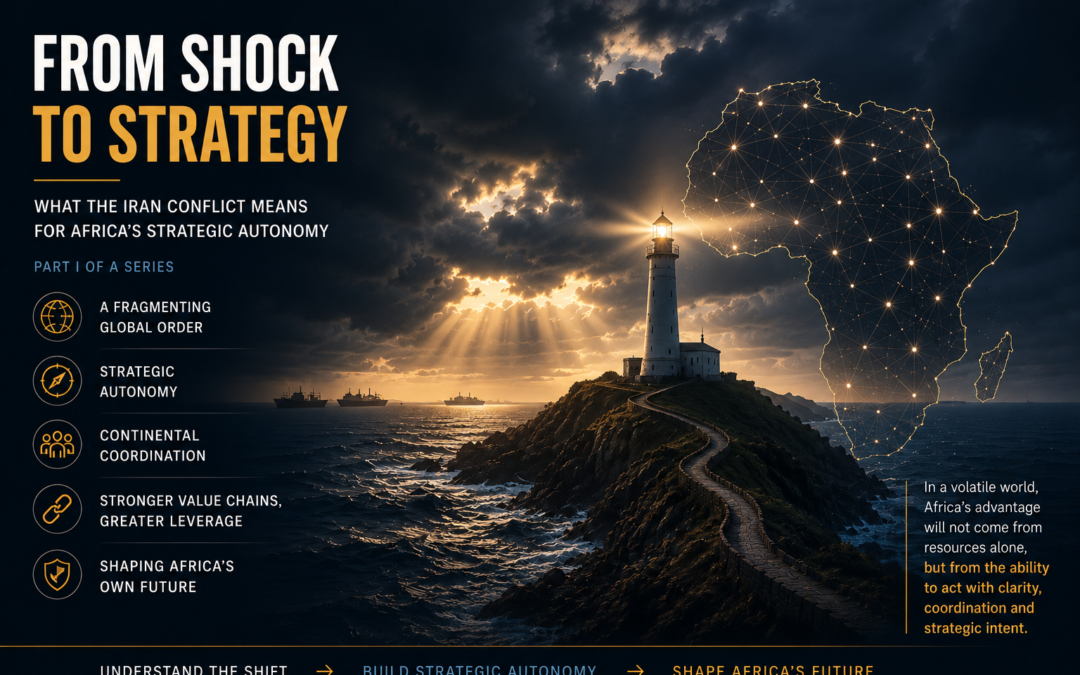
The escalating tensions involving Iran, the United States, and Israel are not simply a regional crisis; they reflect a deeper structural shift in the global order toward fragmentation, transactional alliances, and reduced predictability. For Africa, the implications are immediate: from energy price volatility to supply chain disruptions. However, the more significant challenge lies in how the continent positions itself within this evolving environment. Strategic autonomy must become a central policy priority and achieving it will require not only national-level action but strengthened continental coordination through frameworks such as the African Union, Agenda 2063, and the African Continental Free Trade Area (AfCFTA).
The Iran Conflict Is Not Regional: It Is Structural
The ongoing conflict involving Iran, the United States, and Israel is often framed as a regional security crisis. In fact, it reflects a structural change in the global order, one increasingly defined by loosening alliances, increased global competition and the erosion of predictable governance norms. For African states, the implications are already material. Disruptions to trade routes and energy markets are affecting agricultural exports, inflation and fiscal stability across the continent. From constrained export flows in East Africa to rising input costs for farmers and pressure on energy systems, the effects are both immediate and widespread. Yet the more consequential issue is not the shock itself, but what it reveals. Africa is operating within an increasingly competitive multipolar geopolitical environment, where major powers, regional actors, and emerging middle powers simultaneously pursue influence. In this context, strategic autonomy is no longer a distant aspiration. It is an operational necessity.
A Fragmenting Global Order
The war highlights several structural dynamics reshaping the international system.
First, the relative coherence of US-led global governance is weakening. This is not simply a matter of declining power, but of reduced ability to coordinate collective responses and sustain predictable frameworks for international engagement.
Second, regional powers are exercising greater autonomy. Actors such as Iran, Israel, and Gulf states are steadily shaping outcomes beyond their immediate regions, with global economic consequences.
Third, conflict is increasingly indirect. Proxy dynamics now extend geopolitical tensions into global supply chains, energy systems, and trade flows, amplifying their impact far beyond the immediate theatre of conflict.
Fourth, global energy markets remain structurally fragile. Disruptions in critical chokepoints rapidly translate into price volatility, with cascading effects on food systems, transport costs, and inflation, particularly in import-dependent countries.
Finally, alliance systems are becoming more fluid. States are hedging, diversifying partnerships and engaging on a transactional basis rather than aligning rigidly within fixed blocs.
Why This Matters for Africa
For Africa, these shifts are not abstract but translate into concrete pressures and opportunities. Energy volatility affects exporters and import-dependent economies, creating short-term revenue gains for some while increasing cost of living pressures across the continent. Disruptions to fertiliser supply chains and shipping routes increase agricultural costs, threatening food security and smallholder livelihoods. At the same time, intensifying global competition is increasing external interest in African markets, infrastructure, and resources. This creates opportunities for investment but also risks reinforcing extractive relationships if not carefully managed. The central issue is not exposure to global shocks, which is unavoidable, but the degree to which African states can shape their responses and outcomes.
Strategic Autonomy as a Policy Priority
Strategic autonomy in this context does not imply isolation; it requires coordinated continental action. It refers to the capacity to engage external partners on terms that reflect African priorities while maintaining policy independence. In practice, strategic autonomy at scale cannot be achieved through national policy alone but requires deliberate choices:
First, African states must diversify international partnerships in a way that fosters competition among external actors, improving negotiating leverage and reducing dependency risks.
Second, strengthening continental integration and coordination is critical. Collective platforms, including the African Union, can strengthen bargaining power, improve continental coordination and provide a buffer against external pressure. The African Continental Free Trade Agreement (AfCFTA) is a critical instrument in this regard. Its functionality should be expanded.
Third, investment in domestic value chains, especially in energy, fertiliser production, and critical minerals, moving exploration into processing and higher-value industrial activity is essential to reduce structural vulnerabilities and external dependency.
Fourth, Africa’s renewable energy potential presents an opportunity to reposition the continent within the global energy transition, not as a peripheral supplier but as a strategic actor.
Finally, governance standards must remain central. Diversification of partnerships should not result in new forms of dependency or weakened institutional accountability. Good governance standards must remain the central hallmark of every African nation and global Africa as a whole.
From National Strategy to Continental Coordination
Strategic autonomy at the national level will remain limited without effective continental coordination. Africa’s capacity for influence in a fragmented global system depends not only on the actions of individual states, but on the strength of its collective frameworks.
The African Union provides the primary platform through which this collective voice can be articulated. In an environment increasingly defined by transactional and opportunistic partnerships where external actors seek to engage African states on a bilateral basis, fragmented engagement weakens negotiating power. Africa’s ability to shape outcomes in a multipolar competitive global system depends not only on the actions of individual states, but on the strength of its collective frameworks. Greater coherence under the aegis of the AU will be critical to strengthening Africa’s negotiating position and insulating the continent from external pressure. This is where long-term and structural initiatives become central.
Agenda 2063 offers a strategic vision for continental transformation, while the African Continental Free Trade Area (AfCFTA) provides a practical mechanism for deepening economic integration. Together, they form the foundation for reducing dependency, strengthening intra-African trade, and enhancing the continent’s capacity to engage external partners from a position of greater leverage. Without meaningful progress in these areas, strategic autonomy risks remaining rhetorical. With them, it becomes actionable.
Within this framework, the African Continental Free Trade Area represents a vital accelerator for advancing economic integration and strengthening Africa’s strategic position. By deepening intra-African trade, supporting regional value chains, and reducing dependence on external commodity markets, AfCFTA enhances resilience and expands negotiating leverage.
Its significance is reinforced by alignment with Agenda 2063, which provides the long-term vision for an integrated and globally influential continent. Together, these frameworks move Africa beyond aspiration toward implementation.
However, delivery remains the central challenge. Infrastructure constraints, regulatory fragmentation, and limited industrial capacity must be addressed through sustained policy reform and institutional strengthening. AfCFTA is not a panacea, but it is a catalyst for structural transformation.
From Exposure to Agency
The emerging global order is not inherently disadvantageous to Africa. A more transactional and multipolar system can create space for greater agency if approached with clarity and disciplined execution. Africa faces a choice: it can remain primarily reactive, absorbing external shocks and adjusting at the margins. Or it can act deliberately, shaping partnerships, building resilience, and asserting its interests within a competitive global landscape.
Beyond this lies a more ambitious possibility: to influence the evolving global order itself, particularly in areas such as energy, climate, critical minerals, and demographic scale as strategic assets. The Iran conflict is one manifestation of a broader shift. For Africa, the critical question is not simply how such conflicts unfold, but how the continent positions itself in response. Africa’s challenge is no longer how to respond to global shocks, but how to assert itself within a system where shocks are the norm.
Strategic autonomy is no longer a long-term ambition. It is an immediate strategic necessity. Without progress in these areas, Africa risks remaining structurally peripheral within key global decision-making systems. In a world defined less by order and more by negotiation, influence will belong not only to those with power, but to those with strategy. Africa’s task is to ensure it is counted among them.