
Executive Summary
The global order is undergoing a structural shift. Institutions and frameworks shaped in a different era are increasingly misaligned with current geopolitical realities, particularly for regions such as Africa. As the new world order emerges, Africa has an opportunity to shape the next phase.
Recent geopolitical tensions, such as the escalation involving Iran, the United States and Israel, underscore the extent to which global economic and security systems remain deeply interconnected. Disruptions to critical energy routes such as the Strait of Hormuz have immediate implications for global supply chains, commodity prices, and economic stability. These effects extend well beyond their immediate region. These developments are not isolated shocks but are symptomatic of the dysfunction of the current world order, signifying a broader structural shift toward a more fragmented and transactional international system. In such an environment, the ability to act collectively and negotiate from positions of strength becomes increasingly important. Africa must develop the ability to shape partnerships on its own terms.
Why Coordination is Difficult
Yet while the strategic rationale for continental coordination is becoming clearer, implementation remains difficult in practice. Concerns around ceding sovereignty have historically driven many African countries to impose strong controls on services, for example limits on foreign banks, tight telecom regulations, restrictive work permit regimes, state monopolies in utilities etc. Absence of common continental frameworks for licensing, quality standards, and mutual recognition of qualifications fuels protectionism. Competing national interests and lack of trust between nations present a significant barrier to implementation of AfCFTA. Uneven state capacity, logistical challenges and infrastructure asymmetry pose additional challenges.
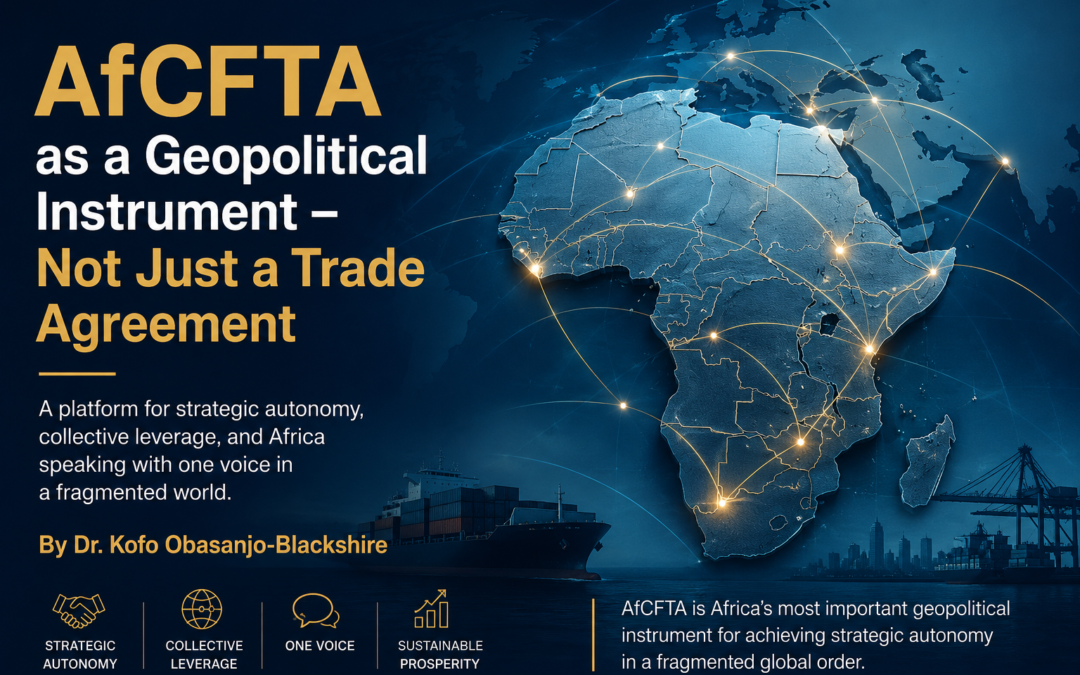
Continental coordination is central to Africa’s strategic autonomy. The African Continental Free Trade Area (AfCFTA) is Africa’s most important geopolitical instrument for achieving strategic autonomy in a fragmented global order. It is a powerful coordination mechanism empowering Africa to engage in global affairs on its own terms. AfCFTA consolidates market power, strengthens bargaining leverage, and enables greater coordination of policy positions. In doing so, it provides a platform through which African states can engage external partners on more balanced terms.
Realising this potential will require targeted action, including regulatory alignment, physical and digital infrastructure investment, and stronger coordination between member states. Greater regulatory openness and alignment will be essential to facilitating effective continental integration. Under the auspices of the African Union and regional blocs, AfCFTA presents a mechanism for fairer and stronger negotiation mandates on trade and resource governance. Greater continental alignment strengthens Africa’s ability to define its own priorities and negotiate from a position of coherence.
Why External Actors prefer Fragmentation
As external powers deepen their strategic engagement across the continent, greater coordination will be essential to ensure such engagements align with African priorities. Bilateral deal-making incentives entice African nations to make individual agreements. While such agreements may serve short-term national interests, they can weaken the collective bargaining capacity and reinforce fragmented engagement. Indeed, aid has been tied to requests to relinquish data and digital sovereignty in recent examples between the US and African states. Fragmentation creates strategic advantages for external actors. Bilateral engagements enable outside powers to negotiate from positions of asymmetrical influence, often prioritising narrow national agreements over broader continental coherence. In some cases, aid, security cooperation and investment agreements may undermine sovereignty, weaken policy autonomy and reinforce dependency dynamics. As external players expand military presence and strategic engagement across Africa, the absence of coherent coordinated continental positions increases the risk of African states becoming arenas for external competition and proxy conflicts rather than independent strategic actors.
Institutional Limitations
The gap between ambition and institutional reality remains significant. AfCFTA was conceived primarily as a trade and integration framework rather than a geopolitical vehicle. Its strategic significance therefore lies less in formal supranational authority and more in its potential to strengthen continental alignment and bargaining coherence over time.
Experiences from regional blocs such as the EU and ASEAN demonstrate that integration depends on sustained regulatory alignment, openness, and institutional coordination; areas where continued progress will be essential for AfCFTA’s effectiveness.
As the current global framework loses coherence, Africa faces a defining choice: continue to operate as a fragmented market or evolve into a coordinated strategic actor capable of shaping its position in the world. The question is whether existing institutional frameworks can evolve sufficiently to support this transformation.