
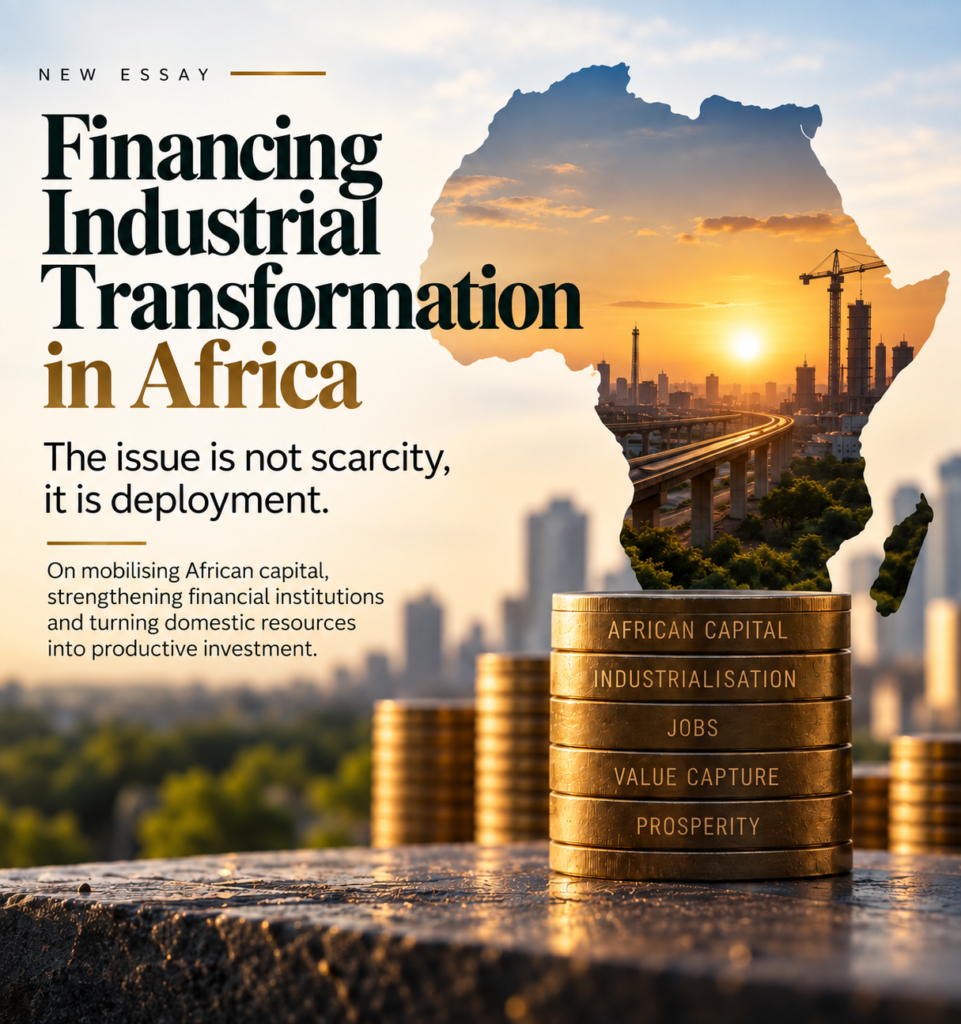
Africa’s development challenge is not merely access to capital, but the institutional ability to strategically mobilise and deploy its own capital without reproducing dependency. Industrial transformation requires patient capital, but current structures incentivise externalisation. The issue is not scarcity, it is deployment.
The Contradiction
Africa’s development challenge is not simply a lack of capital. It possesses an estimated $4 trillion in domestic financial assets. Despite this wealth, the continent faces significant challenges within existing capital structures. It is endowed with conventional and critical minerals, energy, arable land, talent, a vibrant diaspora and markets. What it lacks at sufficient scale are the trusted systems to convert these resources into infrastructure, industrialisation, value capture, jobs and wealth creation.
The Structural Trap
Africa does not inherently lack capital; rather, it faces structural asymmetries hidden within the global financial system. Systems that were developed in a different era no longer reflect current geopolitical realities. African central banks and financial institutions are often constrained by prudential regulations, fiduciary mandates and investment-grade requirements that favour highly rated external assets – primarily US Treasuries and European bonds – which are dominated by Western rating agencies (Moody’s, S&P, Fitch). The reinvestment loop perpetuates a cycle in which EU and US institutions earn stable returns from African reserves before African governments borrow from international markets at significantly higher rates. Dependency is embedded within supposedly neutral financial standards. The structure of financing itself deepens dependency, weakens strategic autonomy and externalises control over development priorities.
The Misallocation Problem
A system that incentivises capital externalisation means a significant proportion of Africa’s capital exits the continent, while its savings are redirected into financing foreign markets instead of funding domestic infrastructure and growth. Capital flight creates shallow domestic financial markets making it difficult to finance industrialisation, infrastructure and prosperity. Coupled with perceived higher risk of investment, African financial markets are left with fewer participants and investment instruments. The absence of deep and liquid domestic financial markets provides justification for continuing to invest abroad. This is why African states have remained heavily dependent on foreign capital and external debt despite growing domestic savings. African states borrow externally at punitive rates to finance their own development. Governments struggle to meet basic development needs, leaving health, education, climate, and infrastructure gaps unresolved. The average public debt in Africa is around 65% of GDP, amounting to $1.8 trillion, with some countries having much higher debt levels. Alarmingly, nearly 40% of African countries are in, or at high risk of, debt distress. Worse still, over 30 African countries now spend more servicing external debt than on healthcare.
Strategic Capital
Long-term infrastructure needs are urgent, but the mechanisms to connect them remain underdeveloped. Infrastructure and sustainable development are by definition long-duration assets, which demand patient capital. Regulations limit participation in more sustainable regional projects. The result is a structural mismatch, which has real consequences for mobilising capital. Investing Africa’s domestic funds into the continent’s development finance institutions would create a deep pool of resources. By placing a portion of their foreign exchange reserves with domestic institutions, African governments can channel these funds towards a self-sustaining African financial ecosystem. This would be a practical step towards developing scalable instruments that can translate domestic savings into infrastructure capital. Deepening domestic financial markets strengthens economic sovereignty, reduces dependence on foreign financial centres and bolsters local capital markets. A greater proportion of African reserves should be strategically channelled through African financial institutions.
Institutional Architecture
Africa needs a financial infrastructure that enables capital to move with confidence. Building an African financing architecture demands a fundamental shift in asset valuation, regulation and investments. It means developing regional investment-grade benchmarks and globally credible African credit ratings institutions that provide contextual interpretation and empirically grounded assessments. African capital markets remain shallow in part because risk perceptions are distorted. AfDB and Afreximbank can function as de-riskers, providing political risk guarantees for African trade and infrastructure transactions, making them much more attractive and legally viable for pension funds. These financial institutions can provide the globally recognised framework to mobilise African institutional funds to invest in intra-African trade and industrial value chains. Afreximbank’s Central Bank Deposit Programme demonstrates the potential of retaining a portion of African reserves within continental institutions capable of financing trade, infrastructure and industrialisation at scale, while still generating competitive returns for participating states.
Internal Constraints:
Capacity deficit within the continental financial ecosystems creates absorptive mismatch with regional assets. Furthermore, Africa loses an estimated $90 billion annually through illicit financial flows. Institutional leakages from transnational crime, tax evasion, and corruption weaken domestic resource mobilisation and undermine the credibility required for long-term capital retention. Over the past five decades, the total cost of illicit outflows from Africa has exceeded $1 trillion. These outflows drain public revenues, undermine economic sovereignty, and deprive governments of the resources needed for development. Curbing these flows is a major priority for African governments, as doing so will help reduce the region’s overall financing gap.
Sovereignty & Coordination
Collective sovereignty requires coordinated financial architecture. Fragmented regulatory systems, shallow capital markets and inconsistent investment standards make it difficult to mobilise African capital at scale. Africa must organise its capital in a manner that supports industrialisation, strategic autonomy and long-term value creation rather than reinforcing dependency. The challenge is not simply raising finance for isolated projects but building coordinated financial systems capable of mobilising African savings toward continental transformation. This requires harmonised financial regulation, deeper domestic capital markets, stronger regulatory frameworks, investable regional project pipelines and credible continental institutions capable of reducing risk and coordinating long-term investment. These are necessary to build investor confidence and retain capital within African productive systems. Without greater financial coordination, capital will continue to leave the continent faster than it can be productively deployed within it.
Africa possesses many of the strategic resources underpinning the global energy transition, the land to feed the world, the youngest workforce, and the natural carbon sinks. Access must be based on its terms and priorities. This is not resource nationalism. It is what every sovereign bloc, from the EU to ASEAN, aims to do: use its collective bargaining power to secure prosperity for its people. Ultimately development finance is not only about liquidity or access to external funding. It is about institutional credibility, strategic discipline and the ability to align capital with long-term developmental priorities.